Chatter Platter
Designing meaningful family mealtime through storytelling and AI.
- Role
- Lead Experience Designer & Researcher
- When
- 2023–2024 · 1 year
- Context
- Keio University
- Built with
- Figma, Stable Diffusion, Physical Prototyping, Video Analysis
Overview
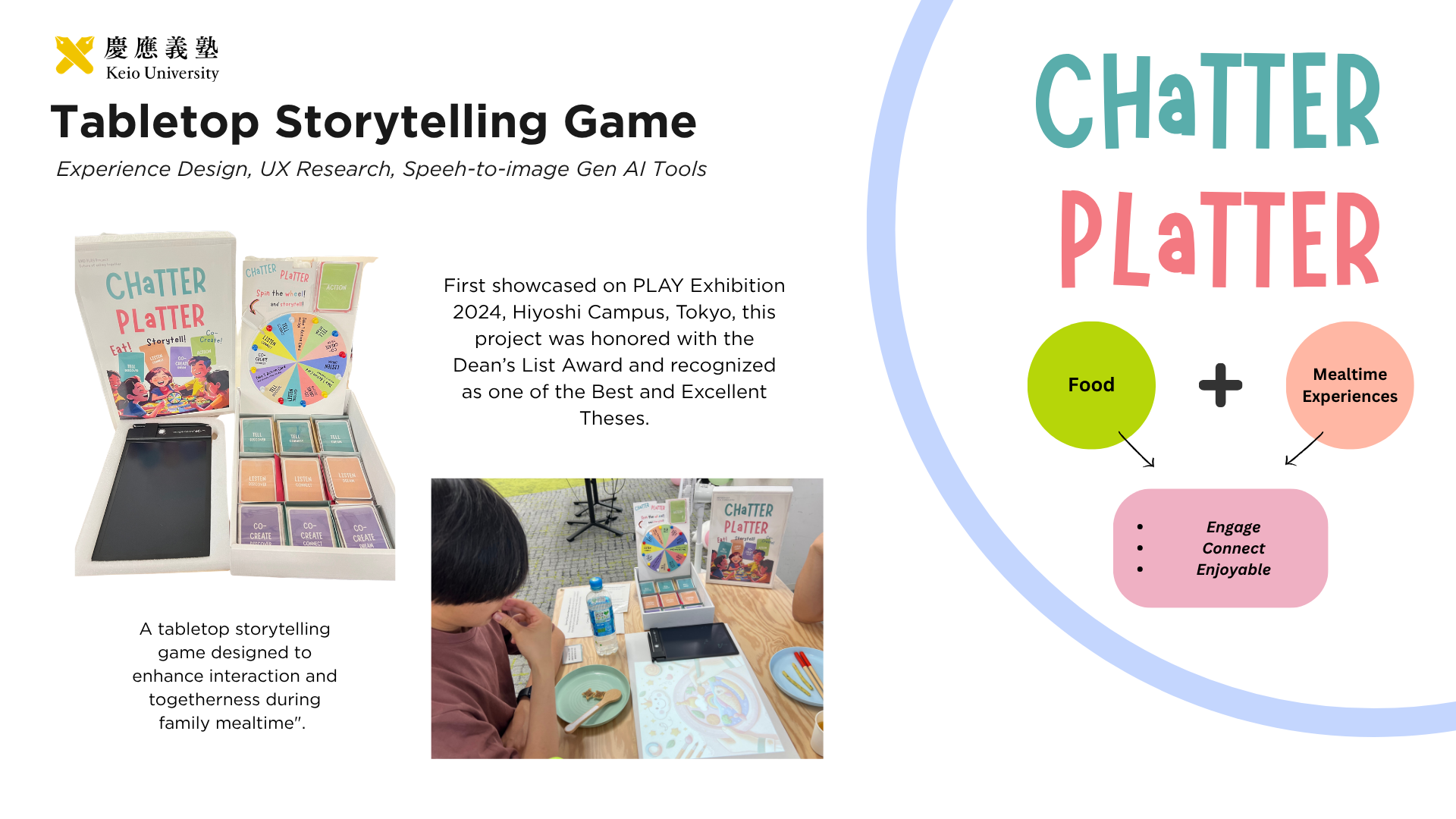
A tabletop storytelling card game combining 54 physical prompt cards, a spinner wheel, drawing pad, and Speech-to-Image AI with Stable Diffusion model to transform mealtimes into meaningful family bonding experiences. Part of the PLAY Project under Prof. Masa Inakage at Keio University's Graduate School of Media Design. Awarded Dean's List as one of the Best Thesis and showcased at PLAY Exhibition 2024.
The problem
Modern families eat together but don't truly connect. 75% of families observed had minimal meaningful conversation during meals. Research on commensality (共食 / Kyōshoku) shows the real problem is the absence of conversation catalysts — families want to talk but don't know what to talk about.
- 122%Longer meal duration
- 27 minAvg conversation
- 150+Exchanges per session
- 6Family groups tested
Research and discovery
- Ethnographic observation — 20+ families in restaurants (video-recorded)
- Literature review — commensality theory (Ochs & Shohet 2006), Human-Food Interaction (Grimes & Harper 2008)
- Engagement framework — Roman et al. (2012) 6-level annotation scheme
- Co-design sessions — iterative card system refinement with real families
Key insight
The real barrier wasn't technology distraction — it was the absence of conversation catalysts. Families wanted to talk but didn't know what to talk about. The card game gives them permission and structure to begin.
Design process
Initial concept — story-themed food decoration in restaurants
User rejection — allergy concerns; killed the concept entirely
Pivoted to home setting with 54 card-based mechanics (3 categories, 4 interaction modes)
4 modes: TELL (one answers), LISTEN (assigns another), COCREATE (all share), ACTION (physical task)
Speech-to-Image AI — players narrate stories; DALL·E generates real-time illustrations
Showcased at PLAY Exhibition 2024, Keio University
The pivot
The first prototype was elaborate food decoration in restaurants. Families rejected it immediately over allergy concerns. I killed that concept entirely rather than iterate on a flawed premise — simplifying to a home card game unlocked everything, including the AI illustration layer families loved most.
Results
- 122% increase in mealtime duration across 6 family test groups
- Engagement rose to 'Influencing' level — 5th of 6 on Roman et al. scale
- Average conversation length: 27 minutes (documented via video analysis)
- 150+ meaningful exchanges per session vs. near-zero baseline
- Showcased at PLAY Exhibition 2024, Keio University
Reflection
Technology should enhance human connection, not replace it. The best experiences are ones where the designed system fades into the background. I learned more from the first prototype that failed than from the final one that worked.
- Experience Design
- Ethnographic Research
- AI Integration
- Physical-Digital Hybrid